I was on a call last week with a friend of mine who told me about one of their customers, a logistics company. A team lead there had a planning meeting where two of her people had built an entire scenario model using AI before the meeting even started. Forecasts, risk breakdowns, three alternative approaches. The other four people on the team showed up with the same slide deck format they've been using for two years. Same structure, same manual process, same timeline estimates.
The meeting went sideways fast. The AI-assisted pair couldn't understand why the others hadn't done basic prep that "takes five minutes now." The others felt ambushed, like the rules of the game changed and nobody told them. The team lead spent the rest of the day doing damage control.
That story doesn't surprise me anymore. I've been hearing versions of it for months.
The gap is measurable now
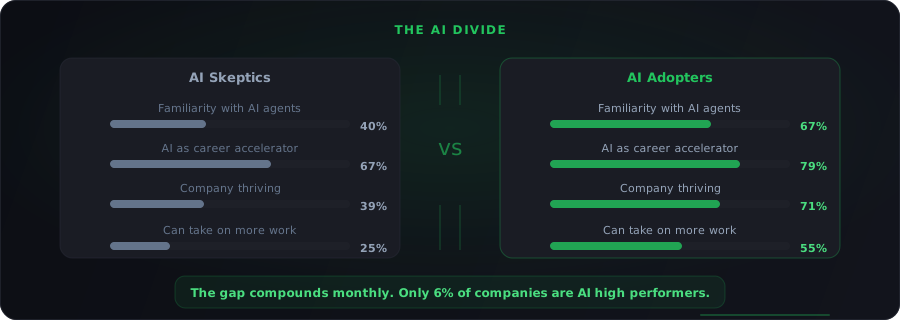
This isn't just vibes. Microsoft's 2025 Work Trend Index, a survey of 31,000 workers across 31 countries, found that 67% of leaders are familiar with AI agents, compared to just 40% of employees. Leaders are far more likely to see AI as a career accelerator (79% vs. 67% of employees), and they're saving more time with it, too. Nearly a third of leaders say AI saves them over an hour every single day.
But here's the part that really stuck with me: when asked how they see AI, 52% of respondents said they treat it as a command-based tool. Give it an instruction, get a result. Only 46% described it as a thought partner, something you have a back-and-forth with.
That's not a small difference. That's two fundamentally different relationships with the same technology. And those two groups are sitting in the same meetings, working on the same projects, supposedly moving in the same direction.
Two speeds, one team
The practical consequence is that teams are now operating at two completely different speeds. The people who've integrated AI into their daily work don't just produce faster. They think differently. They approach problems differently. They arrive at meetings with work that used to take a week done in an afternoon.
And the people who haven't adopted AI (or who've tried it once, found it underwhelming, and moved on) are doing genuinely solid work. I want to be clear about that. It's not that they're bad at their jobs. It's that the ceiling of what's possible has moved, and they're working under the old one.
A Harvard study on generative AI in teams found something remarkable: a single individual with AI outperforms an entire team without it. But a team where everyone uses AI outperforms them all. The implication is brutal. Mixed adoption doesn't give you a middle ground. It gives you friction.
I saw this firsthand at a workshop I ran last month. The participants who used AI regularly were finishing exercises in half the time, then getting frustrated waiting for the rest. The participants who didn't use AI felt rushed and, honestly, a bit humiliated. Nobody intended that outcome. It just happened because the speed gap is that large now.
The competitive advantage nobody talks about
Here's where it gets really consequential. McKinsey's State of AI 2025 survey found that 88% of organizations are using AI in at least one function. Sounds great, right? But nearly two-thirds are still stuck in experimentation and pilot phases. Only about a third have begun scaling AI across their business. And the companies that have scaled, the ones McKinsey calls "high performers"? They represent roughly 6% of respondents.
That 6% is pulling away from everyone else at a speed that I think most people underestimate.
High performers are three times more likely to have fundamentally redesigned their workflows around AI. They're three times more likely to have senior leaders actively championing and role-modeling AI use. Three-quarters of them are scaling or have already scaled AI across their organization, compared to one-third of everyone else.
Microsoft's data tells a similar story. Companies they call "Frontier Firms" (those with org-wide AI deployment and advanced maturity) report dramatically different outcomes. 71% of Frontier Firm leaders say their company is thriving, compared to 39% of workers globally. 55% say they can take on more work, versus 25% globally. And they're less afraid of AI taking their jobs, not more.
The gap between these companies and everyone else isn't narrowing. It's accelerating.
This is a people problem disguised as a technology problem
The temptation is to solve this with tools. Roll out Copilot, buy some licenses, send a company-wide email about AI resources. Done.
But the actual challenge is cultural. It's the team lead on that call trying to hold together a group where half the people feel supercharged and the other half feel left behind. It's the manager who has to explain to a 20-year veteran that their workflow, the one they perfected over a decade, might not be the best approach anymore. It's the junior employee who's quietly using AI to produce senior-level work and doesn't know whether to be proud or worried about political fallout.
Microsoft found that 47% of leaders list upskilling existing employees as a top workforce strategy. That's encouraging, I guess. But upskilling only works if people actually want to learn. And right now, a meaningful chunk of the workforce has decided that AI is either not relevant to them, not reliable, or not worth the effort. Some of them might be right about specific tools. But the broader trajectory isn't optional (I say that as someone who's been skeptical of plenty of tech hype cycles over the years, and this one feels different).
Where this is heading
I don't think the divide goes away. I think it widens. The people who adopt AI will keep getting faster, keep producing more, keep raising the bar for what "normal output" looks like. The people who don't will feel increasing pressure, whether from management, from peers, or just from the ambient reality that their colleagues are doing things they can't.
Companies that figure out how to bring their whole team along, not just the enthusiasts, will have a genuine advantage. And that advantage compounds. Every month of organizational AI fluency is a month your competitors spend arguing about whether to buy ChatGPT licenses.
The biggest competitive advantage in the AI era won't be which model you use. It will be whether your entire team actually uses it.
That logistics team I mentioned? My friend told me the team lead booked a two-day internal workshop. Not "here's how to prompt." More like "here's how this changes the way we plan together." The skeptics needed to see what was possible in the context of their work, not in some generic demo with a made-up scenario. And the enthusiasts needed to learn patience. To bring people along instead of running ahead.
That feels like the job right now. Not just adopting AI. Closing the gap. Before it closes you.