Yesterday Anthropic launched Claude Design, a new product from their Anthropic Labs team that lets you create designs, prototypes, presentations, and marketing collateral by talking to Claude. And I sat there looking at the announcement thinking: okay, so now one person with a Claude subscription genuinely has most of what a small creative agency offers. Design. Code. Automation. Presentations. Brand consistency. All inside the same ecosystem.
That's a wild sentence to write in 2026. But I don't think it is an exaggeration.
What Claude Design actually does
The short version: you describe what you need, and Claude builds a first version. Then you refine through conversation, inline comments, direct edits, or custom sliders that Claude generates for you. It is powered by Opus 4.7 and it is surprisingly good at maintaining visual consistency.
But the feature that caught my attention is the onboarding. During setup, Claude reads your codebase and existing design files to build a design system for your team. Colors, typography, components. Every project after that automatically follows your brand. You can import images, documents (DOCX, PPTX, XLSX), or point it at your codebase directly. There's a web capture tool that grabs elements from your live website so prototypes look like the real product.
Have a Figma mockup you want to iterate on? Export it, drop it into Claude Design, and start a conversation about what to change. Or just capture your existing website and say "make the hero section bigger and add a testimonial carousel." That kind of thing.
The testimonials from the announcement are telling. Brilliant's Senior Product Designer said their most complex pages, which took 20+ prompts to recreate in other tools, only required 2 prompts in Claude Design. Datadog's Product Manager described going from a rough idea to a working prototype before anyone leaves the room, and said what used to take a week of briefs, mockups, and review rounds now happens in a single conversation.
A week of back-and-forth, collapsed into one conversation. Think about that for a second.
The stack that changes everything
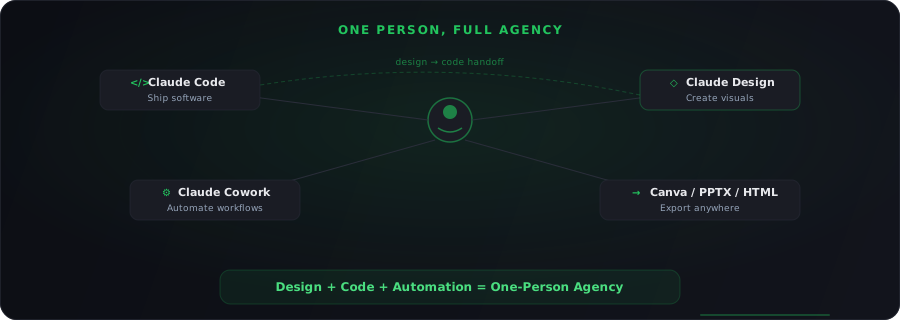
Here is where it gets interesting. Claude Design does not exist in isolation. Anthropic now has three products that, combined, cover an absurd amount of ground:
- Claude Code: Write, review, and ship actual software. $2.5 billion in run-rate revenue as of February, responsible for an estimated 4% of all public GitHub commits worldwide.
- Claude Cowork: Automate knowledge work. Research, analysis, document processing, recurring tasks from your desktop.
- Claude Design: Create visual work. Prototypes, presentations, marketing collateral, brand-consistent assets.
And they hand off to each other. When a design is ready to build, Claude packages everything into a handoff bundle you can pass to Claude Code with a single instruction. Design to production in one flow. No Jira ticket. No handoff meeting. No "can you send me the specs in Slack."
I keep thinking about Sam Altman's prediction from early 2024 about the one-person billion-dollar company. At the time it sounded aspirational, maybe a little hyperbolic. The tools were not there yet. You could generate text and images, sure, but the gap between generating things and shipping real products was enormous.
That gap is shrinking fast.
What I would have given for this two months ago
When I built Rasepi, the marketing site was one of the most tedious parts. Not the code. The code was fine, Claude handles HTML and CSS like a champion. But the visual design decisions? The hero layout, the pricing page cards, the feature comparison tables? I described things in words, Claude produced something, and then I spent hours going back and forth trying to adjust spacing, colors, typography. All through text prompts. No visual feedback loop.
With Claude Design, that workflow becomes: "here is my website" (web capture), "redesign the pricing section to emphasize the team plan" (conversation), tweak the green accent color with a slider, approve, hand off to Claude Code for implementation. I estimate that would have saved me an entire weekend.
(Honestly, I'm a little annoyed it did not launch two months earlier.)
And the Canva export is clever. Canva has 220 million active users and $3 billion in annualized revenue. Anthropic is not trying to replace Canva. They're trying to be the place where ideas start before landing in Canva for final polish and distribution. That is a smart positioning play. You generate the creative in Claude Design, then export to Canva where your marketing team picks it up. Or export to PPTX for that investor deck. Or export as standalone HTML for a landing page.
The "just add tools" multiplier
This is the pattern I keep seeing across the AI space in 2026. The base model gets smarter, sure, but the real productivity jump comes from connecting tools together. Claude by itself is a very smart text generator. Claude with Code is a software engineer. Claude with Cowork is a research analyst. Claude with Design is a creative director. Claude with all three? That's a small agency.
And the connections keep growing. Anthropic said they will add more integrations over the coming weeks. MCP servers already let you connect Claude to external tools and data sources. The ecosystem is building itself.
For solo founders, freelancers, and small teams, this changes the calculus completely. You don't need a designer on retainer to produce professional-looking decks and prototypes. You do not need a separate frontend developer to turn mockups into code. You don't need a project manager to coordinate the handoff between design and engineering because there is no handoff. It is one continuous conversation.
I'm not saying designers are obsolete. Far from it. Brilliant and Datadog both described their designers using Claude Design. The tool makes good designers faster and gives everyone else access to competent visual output. That's a different thing from replacing people.
What this means for documentation products
This one I'm watching closely. At Rasepi, we're building a documentation platform where visual quality matters. Entry pages need to look good. Quick-start guides need clear diagrams. Marketing docs need brand consistency across languages and teams.
A world where every team member can generate on-brand visual documentation, hand it off to the translation engine, and distribute it in seven languages without touching Figma or Photoshop or InDesign? That's exactly the problem we are solving from a different angle. (And yes, this is exactly the kind of workflow Rasepi is built to support.)
The part where it gets weirdly expensive
So here is the thing nobody is talking about yet. I created a brand new Anthropic account specifically to try Claude Design. Fresh account, no history, no prior usage. I imported one small Figma file and generated a single asset. That was it. Two operations. And I was out of credits.
On a brand new account. With a fresh allocation.
I don't know what the token math looks like on Anthropic's side when Opus 4.7 is doing visual generation, but whatever it is, it burns through credits at a pace that makes the "one-person creative agency" pitch feel a lot more expensive than expected. If importing a small Figma mockup and producing one image eats your entire budget, the economics of using this as your daily design tool don't work yet.
To be fair, this is a research preview and pricing will probably change. But right now there's a meaningful gap between the promise (replace your design workflow) and the reality (you might run out of credits before lunch). The productivity gains are real. Whether the credits-per-output ratio makes it practical for regular use is a different question entirely.
The honest caveat
Claude Design is in research preview. It will have rough edges. The testimonials are from design teams at well-funded companies with established design systems. Your mileage will vary, especially if you are starting from scratch with no brand guidelines to feed it.
But the trajectory is clear. Eighteen months ago you needed a designer, a developer, and a project manager to go from concept to shipped landing page. Today a single person with a Claude subscription can do a surprisingly credible version of that same workflow in an afternoon.
We are not at the one-person billion-dollar company yet. But the one-person creative agency? I think we just arrived.